A watering system the grower can own.
I started Souveraineté with a friend who grows vegetables. We asked what irrigation would look like without a cloud service or locked hardware. I built the identity, interface and working simulator; the field hardware is designed but not deployed.
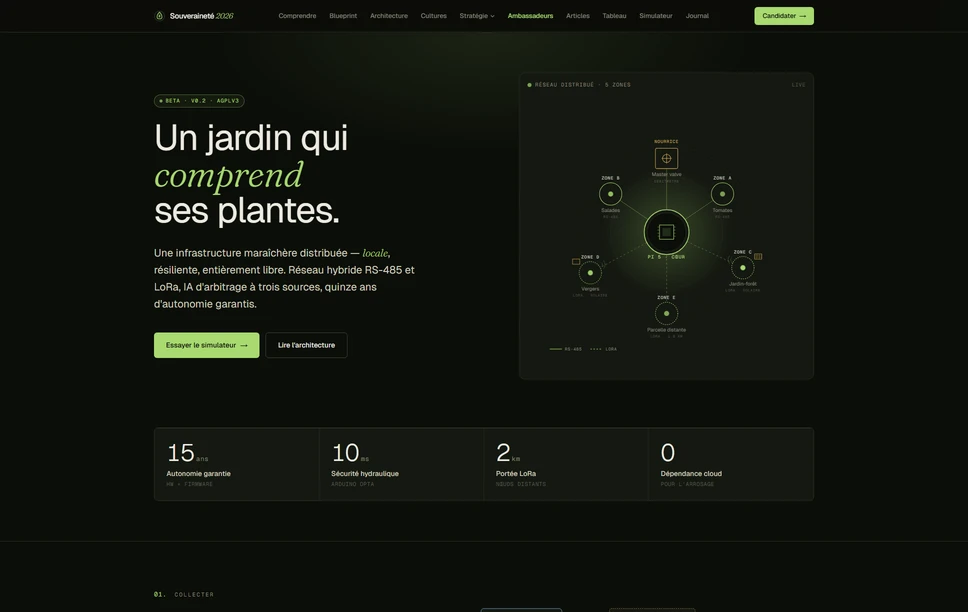
The grower set the rules.
Many agricultural systems send data to someone else's cloud and hide the decision logic. We wanted a local system the grower could understand and repair with ordinary tools.
My friend set three hard constraints. He must be able to bypass the electronics with a valve. A physical panic button must stop the system. Irrigation decisions must still work without a connection. Those refusals shaped the design.
Three sources. One arbitration.
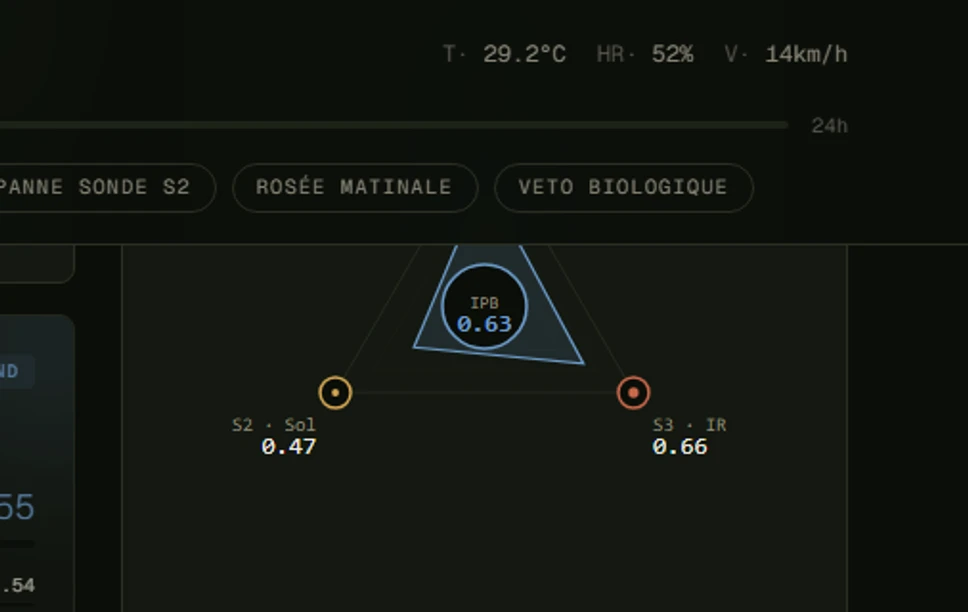
The Triangle de Vérité compares three independent sources before water moves. I designed it on the assumption that any sensor can be wrong.
What theory says
Penman-Monteith evapotranspiration from FAO weather data estimates today's need.
What the ground says
Capacitive probes at six depths measure the root zone; a Kalman filter reduces noise.
What the plant says
Foliar infrared reads the leaf. Thermal stress gives the plant an immediate veto.
Science and soil feed a need-probability score tuned to the growing profile: conventional, MSV, permaculture or organic. If they diverge, the system enters doubt mode and asks the grower. A manual override always wins.
Each layer can survive the others.
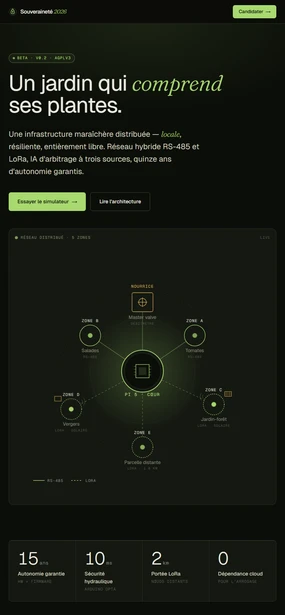
The proposed hardware uses a Pi 5, Arduino Opta controllers and five zones on a wired-and-radio network. Each layer has a fallback.
Autonomous nodes
Each Opta runs a 10 ms safety cycle, so a zone can keep irrigating if the Pi fails.
Hybrid network
RS-485 serves nearby zones. LoRa reaches parcels up to two kilometres away, with solar-powered remote nodes.
Hydraulic sanity
A master valve depressurises the idle network. A flowmeter flags a mismatch between expected and actual flow.
Human failsafes
A hardware panic button stops the system. A watchdog and manual valves provide separate fallbacks.
Confidence threshold
Below the threshold, the system pauses and asks the grower.
Safe-Switch succession
With AGPLv3 and public code, the planned six-month unlock gives the grower full admin if I disappear.
The part that works today.
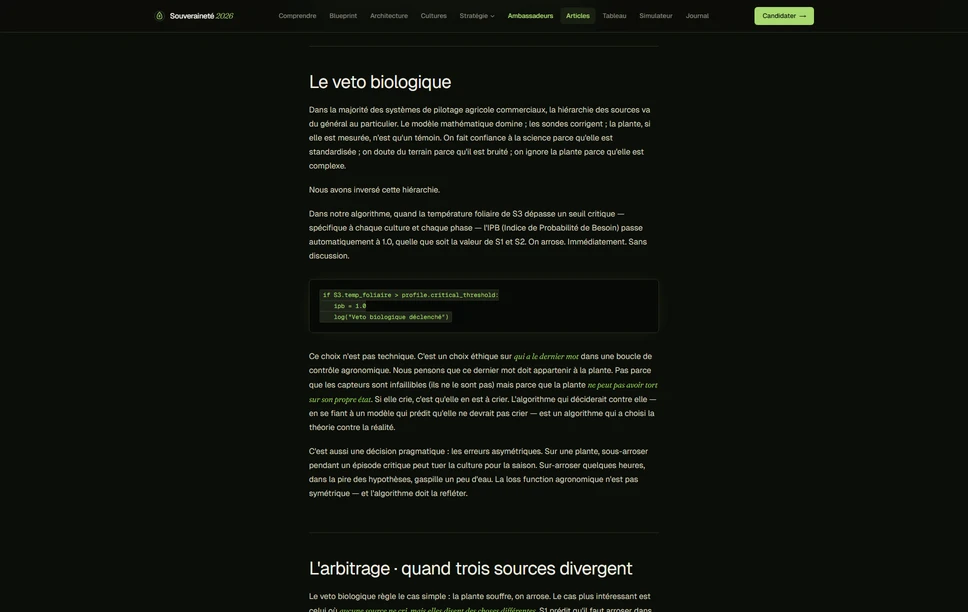
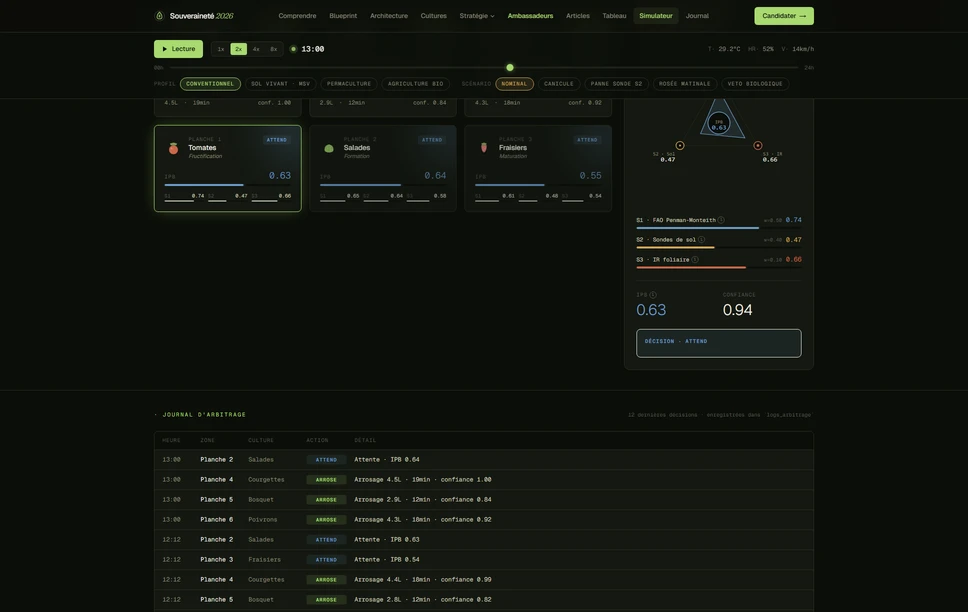
The browser simulator covers six crops and four agronomic profiles across six zones. I can force a heatwave or disable a sensor, then watch the system enter doubt mode, trigger the plant veto or ask for help. It lets me test the logic before hardware exists in the field.
A botanical terminal.
I mixed instrument-panel typography with botanical colour and seed-packet-like maps. The French copy follows the project's promise: pour que chaque maraîcher reste maître de sa terre. Dense telemetry stays readable, with the grower in control.
Sovereignty, expressed in every layer.
"The simulator lets me test the logic before I claim the hardware works."
A wider visual practice: 224 pieces on one infinite canvas.↗